Yourwhole
property,with the price
in plain sight
without fivevendors.

Published pricingNo lock-inNo card, nothing to installFive languages, made in Argentina

Published pricing, no lock-inTape chart with previewRevenue included, not a separate modulellms.txt · readable by an AI272 tools that execute10 currencies, rate frozen at check-inGuest emails without SMTP setupLinkHub with QR38 guided tours over the real screen

What others don't say

Six things you can verify before talking to anyone.

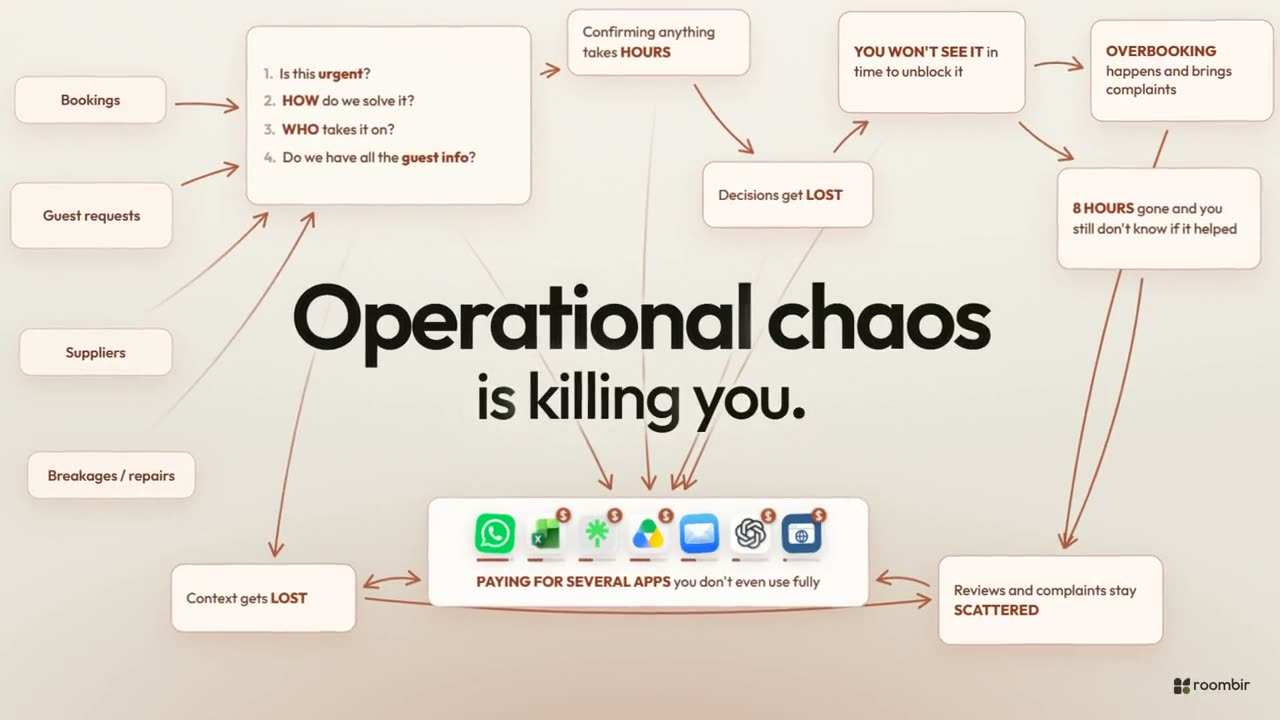
In this category the price is requested through a form, the lock-in shows up on the second invoice and what is missing comes out in week three. Here it goes the other way: each of these six lines has a place where it can be checked.

Published pricing

The plans and what each one includes are on the site, in HTML, with a number. They come from the same catalog that bills your account.

Verify

No lock-in

Monthly. If nothing changed for you in two weeks, there is nothing to cancel and nobody will call to keep you.

Verify

0% on what your engine sells

What comes in through your link is entirely yours. No percentage per booking, no transaction fee.

Verify

Revenue in the catalog, not on the side

Almost everywhere the RMS is a module quoted separately. Here it is one more product, and the plan comparison tells you which plan includes it.

Verify

Public product status

What works, what half-works and what does not exist, area by area. Channel manager and payments, for instance, not yet.

Verify

An AI can read this site

It has its own llms.txt with the same numbers as this page. We practice it before asking it of you.

Verify

Why it exists

Seven products you buy separately today.

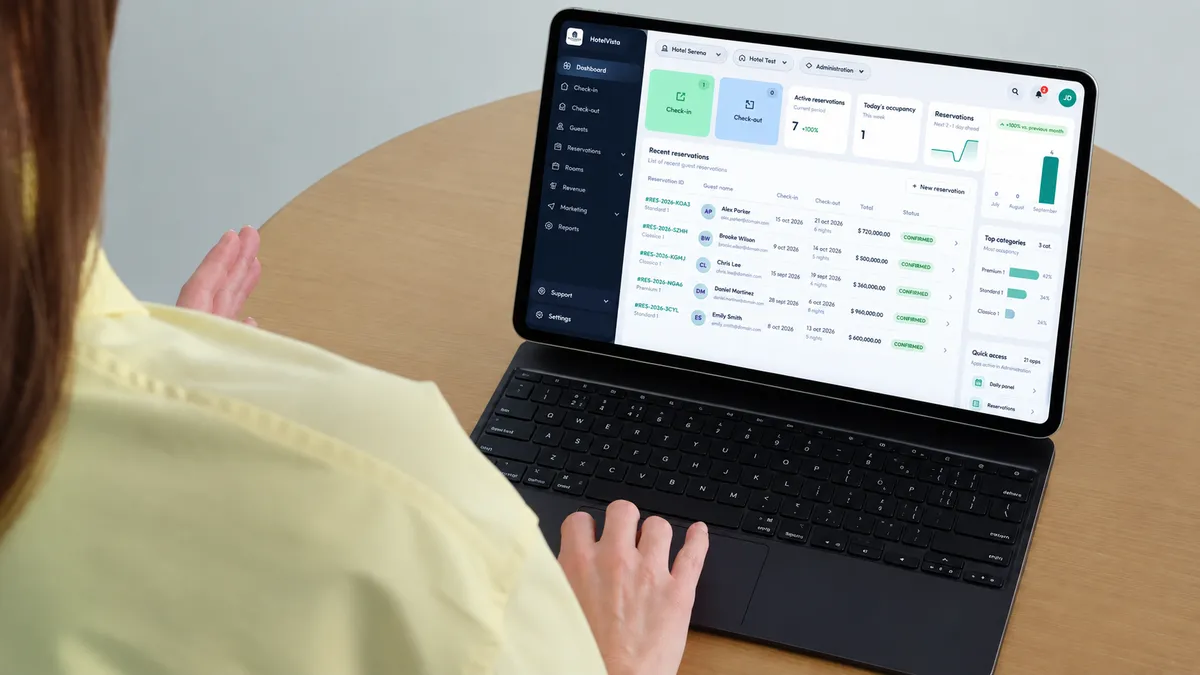
A small or mid-sized property should not need five vendors and a consultant to operate digitally. That is roombir's thesis, and it is what settles every product decision inside.

What you buy separately todayIn roombir
PMS for bookings and roomsBookings + Rooms areas
Booking enginePublic engine + Engine Studio
Website builderBuilder + renderer with your own domain
Revenue management systemRevenue area
Link-in-bio and digital presenceLinkHub + Online Presence
Guest portalStayPass
Assistant / automationsRoombir AI

An ordinary Tuesday

The same day, with and without roombir.

Not a promise of more bookings: a front-desk day at a twelve-unit property. The left is what we hear on the first call; the right is what the system does at each of those moments.

TodayWith roombir
08:10Three WhatsApp messages asking about weekend availability. You open the spreadsheet to answer one by one.All three already looked at the engine calendar: price and units left, day by day. Two booked on their own.
09:30A guest paid a deposit in pesos a month ago. You recalculate by hand what is still owed, at today's dollar.The booking keeps the conversion and freezes it at check-in. The balance did not move.
11:00García arrives and you don't know which room. Neither does housekeeping.Front desk asks the assistant to move him to 203 and email him. Housekeeping sees it on its board without anyone messaging.
14:20You find out the Alerce cabin was sold twice for Saturday.Impossible: every night of every unit is a unique lock in the database. The second booking never got in.
17:00The person who built the website isn't answering and the suite price is still old on the site.You changed the price in Rates and it is already in the engine, on the site and in the LinkHub. You published nothing.
19:45You wonder whether Saturday should go up. You decide on a hunch.Revenue shows +15% with the reason written out: occupancy, pace and an event three days away. You accept and it goes to the engine.

What nobody else has

Every desk sees its system, not yours.

Front desk, housekeeping, marketing and admin work on the same data, but each workspace has its own menu, its own home screen and its own permissions. Nobody learns to ignore half an application.

  • The menu builds itself: a marketing workspace does not show the Bookings area.
  • The home screen recomposes: front desk sees check-ins, housekeeping sees units being cleaned.
  • Permissions are per app and per level: operate, configure or nothing.
  • A new hire's onboarding is built from what that workspace has, and nothing else.

Selling model

A hotel and a cabin do not sell the same way.

Almost every system picks a side: either it is for urban hotels or it is for vacation rentals. Here the mode is set per category, and there is an assistant to migrate from one to the other once you already have bookings inside.

Category pool

The category groups N interchangeable rooms. The guest buys “a Superior Double”, not room 203, and the engine picks the unit on confirmation — minimising gaps or balancing wear, whichever you prefer. You can also leave it unassigned so the front desk decides.

Urban hotel · hostel · aparthotel

Single unit 1:1

The category wraps exactly one unit and sells it by name. The guest books the Alerce cabin, with its photos, its description and its price, and there is no ambiguity about what they got.

Cabins · apartments · glamping · villas

Booking engine

A calendar that sells, not one that asks for dates.

The engine's date picker shows, day by day and according to what you enable, the price from, how many units are left and which days are closed. If you prefer, one switch turns it off and it becomes a plain date picker.

  • Price from and remaining units on every day of the month.
  • Closed to arrival, closed to departure and minimum stay, flagged where people look.
  • Seven configurable checkout blocks, with no code and no republishing the site.
  • The guest confirms by email or you do: pending bookings expire on their own.
See the whole engine

The bet

Your property, bookable by an AI.

People no longer only search on Google: they ask a model. A property an agent cannot read does not appear in that answer. The engine publishes its inventory in machine-made formats, and the GEO editor lets you declare what your property is, for whom, and what makes it trustworthy.

  • llms.txt — who you are, what you sell and how to book, in plain text.
  • availability.json — real availability, machine readable.
  • engine-capabilities.json — which operations your engine accepts.
  • JSON-LD on the pages and a per-page GEO editor: intent, entities and trust signals.
How the agentic layer works

Revenue · RMS

It tells you the price and why.

The RMS is not a black box that spits out a number. Every property and every date has a decision document: what data it saw, which rules matched, whether a cap applied and what came out, line by line.

  • Pace against your own history, split by weekday, month and lead time.
  • If there is little history, the screen says so: it does not sell you confidence that is not there.
  • Demand events ingested on their own — holidays, fairs, concerts — and curated by you.
  • Accept a recommendation and the rate goes into the engine. The loop closes without copy-paste.
See Revenue

Roombir AI

An assistant that operates, not one that suggests.

It is not a chat explaining where to click. It checks availability, creates bookings, moves a stay with a preview, adjusts rates, approves RMS events or publishes a site. And it does all of that with your permissions, not its own.

  • 272 tools covering practically the whole surface of the product.
  • You see the turn transcript: which tool it used and what came back.
  • It answers with actionable cards, not just text.
  • Three permission layers: filtered before the turn, context in the prompt and evaluation on every call.
See Roombir AI

Three things you will not have to think about

The structural guarantees.

unit + date

A night cannot be sold twice

Every night of every room is a unique lock in the database, not a validation two people booking at once can slip past. Maintenance blocks use the same lock, so they take real inventory out and disappear from the engine.

base · charge · display

The amount charged does not move on you later

Prices live in a base currency, you charge in another, and the guest can look in a third. The conversion stays live until check-in and freezes there. For Argentine pesos you pick which rate to use: blue, MEP, CCL or official.

reservations@roombir.com

You do not configure a mail server

Every guest email — confirmation, token, change notice — leaves from roombir's domain with your inbox as reply-to. It is one of the classic frictions of setting up a PMS and it was removed on purpose.

The real size

Not promises: it is already built.

Roombir is in a market pilot, so we are not going to show you an inflated hotel counter yet. What we can show is what is inside the product today.

23apps you can switch on per workspace
272tools the assistant handles
38guided tours over the real screen
10currencies, with blue, MEP, CCL or official for ARS
5platform languages
1single database for the whole system

Marketing

Your site, your brand and your link, served by the same system.

The visual builder assembles the site with components that connect themselves to your data: the embedded engine, room cards, galleries, promotions and reviews. And LinkHub is the page that goes in your Instagram bio, with its QR and its analytics.

  • Your own domain and multiple languages, each with its own URL, cover and social preview.
  • A single brand identity — logo, palette extracted from the logo, tone, narrative — that feeds the site, the engine and LinkHub.
  • Ten LinkHub block types, with date scheduling and visit and click analytics.
  • Reviews importable by CSV, with hotel replies and their reflection on the site.
See website and brand
C

Cabañas del Alerce

Villa La Angostura · Neuquén

Book onlineWhatsAppCabin photosHow to get hereReviews · 4.8

Guided setup

You set it up on your own, in an afternoon.

Nine steps in three stages, with progress saved on the server: you can drop it halfway and pick it up on another device. A card on your desktop takes you back to where you were.

Stage 1 · steps 0–4

Configuration

Your company, your property with an address on the map, time zone and currency, your brand identity — the palette is extracted from your logo — and how you operate. That last step is what produces the workspaces and the initial apps.

Stage 2 · steps 5–7

Loading data

Room types and units, with bulk creation so you do not enter the same thing twenty times. Then the first promotions and a pass over the engine. When the stage closes, availability initialises itself.

Stage 3 · step 8

Tours

Every app you were given has a guided tour drawn over the real screen, highlighting the element it is talking about. From then on, every new person on the team gets onboarding for their workspace.

One system, one price

Everything a property needs to operate and sell, without five vendors and without a commission per booking.

Inicial

Para poner el alojamiento a operar y recibir reservas online

Freefor 60 days
  • Habitaciones
  • Reservas
  • Motor de reservas
  • Informes
  • Revenue (RMS)
  • Sitios web
  • Identidad de marca
  • Galerías
  • Reseñas
  • LinkHub
  • Presencia online
  • Librería de archivos
  • StayPass
  • Bookfer IA
Up to 1 propertyUp to 3 users
Start now
Most chosen

Profesional

El alojamiento completo: operación, marketing y presencia web

USD 79per month
14-day free trial
  • Habitaciones
  • Reservas
  • Motor de reservas
  • Informes
  • Sitios web
  • Identidad de marca
  • Galerías
  • Reseñas
  • LinkHub
  • Librería de archivos
  • StayPass
Up to 3 propertiesUp to 15 users
Start now

Full System

Todo bookfer, incluido revenue management y el asistente de IA

USD 199per month
14-day free trial
  • Habitaciones
  • Reservas
  • Motor de reservas
  • Informes
  • Revenue (RMS)
  • Sitios web
  • Identidad de marca
  • Galerías
  • Reseñas
  • LinkHub
  • Presencia online
  • Librería de archivos
  • StayPass
  • Bookfer IA
No property limitNo user limit
Start now

Product status

What we do not do yet.

We are in a market pilot and we would rather you knew before starting than in week two. These are the four things a large competitor has and Roombir does not, today.

See the full status, area by area

Channel manager

does not exist

There is no inventory or rate sync with OTAs. There is an event log recording every booking change for when it gets connected, but today it is a file, not an integration.

Payment gateway

does not exist

Nothing is charged online. Payment happens at check-in, in person, with the currency conversion frozen at that moment.

Competitor rates

partial

The comp set discovers itself by proximity and similarity, but external competitors' rates are entered by hand. The connection to automatic providers is prepared and not connected.

Online presence

partial

Google Business and OTA listings are edited and scored inside the system, but they are not published by API: today they are copied to the destination by hand. Social connections are declared.

Frequently asked questions

Does it work for cabins and apartments, or only hotels?

Both, and not with the same trick. A category can sell as a pool — ten interchangeable doubles, the guest buys “a double” — or as a single unit 1:1, where the category wraps one unit with its own name. You choose per category, not per system, so a complex with six cabins and two standard rooms coexists without forcing anything.

Do I need a channel manager to use roombir?

Not to operate, but let us say it plainly: Roombir does not have a channel manager yet. If you sell on Booking or Expedia, that availability is reconciled by hand today. The system is built so that direct bookings — your site, your LinkHub, your engine — stop getting lost in a chat, which is where most of the revenue you are not controlling comes from.

How do I collect payment?

At check-in, in person. There is no integrated payment gateway yet. What there is, is real multi-currency: you store prices in a base currency, charge in another, and the conversion stays live until check-in and freezes there so the amount charged does not change afterwards.

Do I have to install or configure anything?

You get in through the browser. Setup is nine guided steps saved on the server — you can drop it halfway and continue from your phone — and there is no mail server to configure: every guest email leaves from roombir's domain with your inbox as reply-to.

Can I use my own domain?

Yes. Every published site takes its own hostname, and each language variant can have its own. LinkHub also has its own public address, with a printable QR code.

Can the AI do anything at all inside my system?

No, and that is on purpose. The assistant operates impersonating your real identity with a short-lived permission reissued on every call. Before the turn, the tools your user cannot use are taken off the table, and every operation is re-evaluated against the service policy. If access is revoked mid-conversation, the next action fails and the assistant explains why.

Why do you publish the price when nobody else does?

Because the alternative is that you request it through a form, someone calls you, and you learn the number in the second meeting. The plans come from the same catalog that bills your account and they are in HTML, so an AI model can read them too when someone asks what a PMS costs. See pricing.

Is there a lock-in?

No. The plan is monthly and there is no penalty for leaving: you write to hola@roombir.com, we give you a reasonable window to download what you want to keep, and that's it. It is in the terms, not in a phone call.

How is it different from Cloudbeds or Little Hotelier?

In three things you can verify: the price is published, there is no lock-in, and revenue management and the AI assistant are in the catalog instead of quoted separately. And in two they have and we don't yet: channel manager and payment gateway. We put it in writing, with a date, in the comparisons.

Get it running this week.

Setup is guided and asks for no card. If you would rather have us alongside for loading rooms — the step that costs the most — we do it on a short call.

01You sign up and load the property.

02We load the rooms together if you want.

03You publish your site and your booking link.